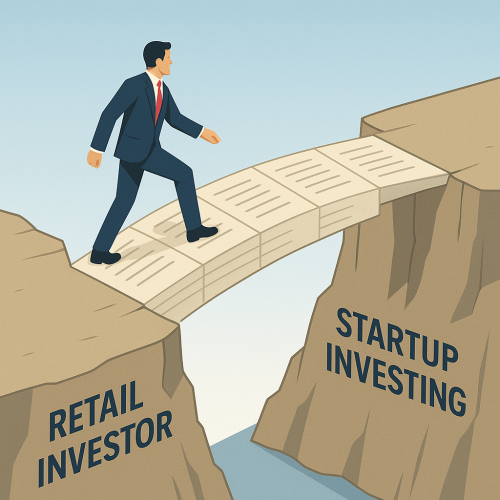

Investing in promising startups has always been an exclusive activity for venture funds, large institutions, or the ultra-wealthy (Angel Investors). While it’s true that investing in startups is very risky, with more than 50% of startups failing, a well-diversified startup investment portfolio has historically shown an annual return of 20% or more.
Understanding Venture Capital and Angel Investing
Venture capital (VC) involves pooling money from institutions and wealthy investors into a fund managed by professional investors. These funds are then used to invest in high-potential startups. The goal is to identify and support companies that can generate outsized returns, compensating for the high risk and frequent failures within the portfolio.
Angel investing, on the other hand, is when affluent individuals invest their own money directly into startups. Both VC and angel investing play crucial roles in the startup ecosystem, providing much-needed capital and expertise to early-stage companies.
The Exempt Market and Accredited Investors
In Ontario, startup investing falls under the exempt market, meaning it’s not subject to the same regulations as public market investments. Participation in the exempt market has traditionally been restricted to accredited investors who must meet stringent financial criteria, such as:
- Having at least $1 million in financial assets (excluding their primary residence).
- Earning an annual income of $200,000 individually or $300,000 with a spouse.
- Possessing a net worth of at least $5 million.
These requirements aim to ensure that only individuals who can afford to lose their investment without severe financial repercussions participate in these high-risk opportunities. While this protects less experienced investors, it also excludes many knowledgeable and financially capable individuals from investing in startups.
Meet The new kids on the block: The Self Certified investor
Last year, the Ontario Securities Commission (OSC) introduced a pilot program to open the exempt market to a new class of investors: the Self-Certified Investor. This program targets individuals who, while not meeting the traditional financial thresholds, possess the necessary business knowledge through education or experience to make informed investment decisions.
The Self-Certified Investor program allows qualifying individuals to invest up to $30,000 per year in the exempt market. This initiative aims to democratize access to startup investments, enabling more people to support innovative businesses and potentially earn significant returns.
The Potential and the Risks
Startup investing can be a great way to support innovation and entrepreneurship while also potentially earning a healthy return on your investment. However, it’s essential to understand the risks involved and to diversify your portfolio. The high failure rate of startups means that while some investments may yield substantial returns, many may result in losses.
Looking Ahead
The introduction of the Self-Certified Investor program is a welcome step towards broadening participation in the startup ecosystem. However, significant barriers remain, making it challenging even for self-certified investors to navigate the landscape effectively. In my next article, I will delve into these challenges and discuss strategies to overcome them.
Stay Connected
If you’re interested in learning more about the Self-Certified Investor program, I highly recommend reading the policy on the OSC website: Self-Certified Investor Prospectus Exemption.
Stay tuned for more insights on navigating startup investments as a self-certified investor. Follow me or connect with me if you’re interested in exploring startup investing further and being part of this exciting journey.